Claude Opus 4.7 vs GPT-5.5 — Which AI Coding Agent Should Developers Choose?
A source-backed developer comparison of Claude Opus 4.7 and GPT-5.5, focused on tool surfaces, repo evaluation, supervision cost, and coding-agent trade-offs.

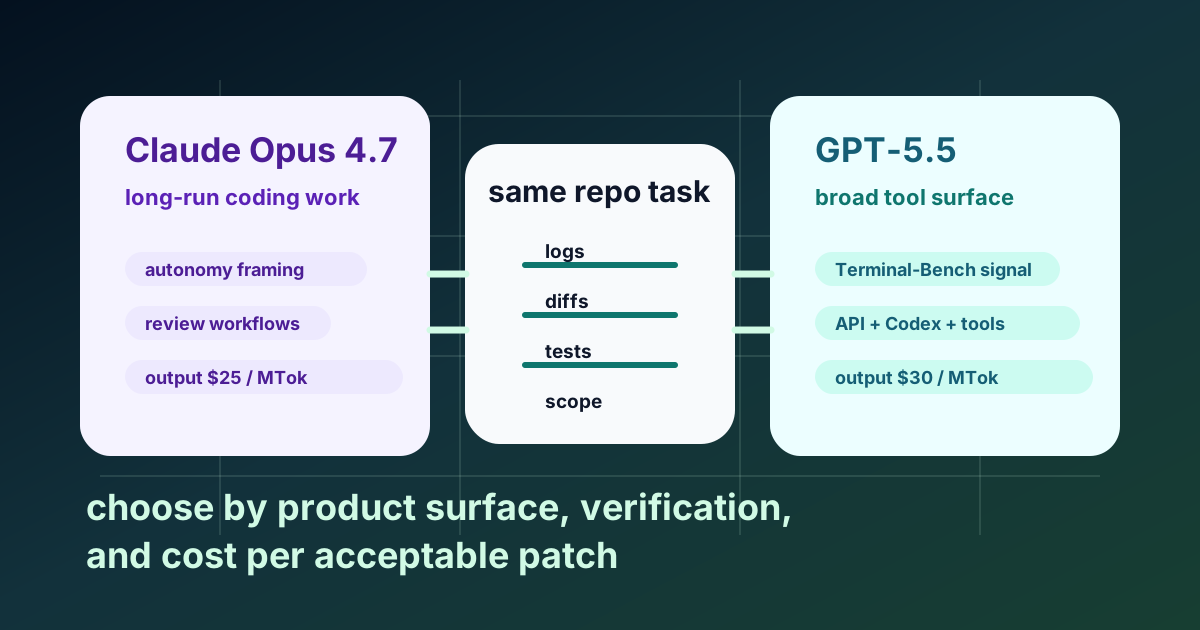
What you are actually choosing
Most developers searching for Claude Opus 4.7 vs GPT-5.5 are not comparing abstract intelligence. They are choosing a daily working partner for code, shell commands, logs, diffs, and review.
That is why benchmark screenshots alone are not enough. A coding agent is the model plus its tool surface, context limits on the product you actually use, effort controls, retry pattern, and failure style when your repository is messy.
| If your priority is... | Start with... | Why |
|---|---|---|
| Terminal-heavy coding tasks with broad OpenAI tool access | GPT-5.5 | OpenAI's docs and launch material position it around coding, web/file/computer tools, and a stronger published Terminal-Bench 2.0 result. |
| Long-running work, review posture, and Claude Code workflow fit | Claude Opus 4.7 | Anthropic's launch material emphasizes sustained autonomy, higher effort levels, and review-oriented tooling such as /ultrareview. |
| Lowest output list price in the API | Claude Opus 4.7 | Anthropic lists $25 per million output tokens, while OpenAI lists GPT-5.5 at $30 per million output tokens. |
| Lowest real engineering cost | Test both | The model that reaches a mergeable patch with fewer corrections can be cheaper even if its list price is higher. |
The timeline matters too. Anthropic announced Claude Opus 4.7 on April 16, 2026. OpenAI announced GPT-5.5 on April 23, 2026 and added an update on April 24, 2026 saying GPT-5.5 and GPT-5.5 Pro were available in the API. If a comparison post blurs those dates, it is already less trustworthy.
For a developer, the useful comparison has five layers:
- Raw model capability.
- Tool access on the surface you use.
- Scope control during long tasks.
- Verification behavior.
- Supervision cost.
Supervision cost is the layer people skip. A model can look great in a launch table and still be expensive in your hands if it widens scope, needs repeated correction, or produces diffs you would never merge.
AI coding agent choice
├─ Can it understand the task?
├─ Can it use tools reliably?
├─ Can it stay inside scope?
├─ Can it verify before claiming success?
└─ Can my team afford the retry pattern?
What the official model docs actually say
Anthropic's launch post describes Opus 4.7 as generally available and aimed at advanced software engineering, long-running tasks, stronger instruction-following, and self-verification behavior (Anthropic announcement). Anthropic's model overview lists claude-opus-4-7 with a 1M-token context window, 128k max output, January 2026 reliable knowledge cutoff, and pricing of $5 per million input tokens and $25 per million output tokens.
OpenAI's API docs say to start with gpt-5.5 for complex reasoning and coding. The same docs list a 1M context window, 128K max output, tools including functions, web search, file search, and computer use, a December 1, 2025 knowledge cutoff, and pricing of $5 per million input tokens and $30 per million output tokens.
Those are the documented vendor positions. They do not prove one model is better for every repo. They do tell you where each company is aiming the product.
Product surface matters more than people admit
This is where many comparison articles go wrong. They state one context number as if it applies everywhere.
For GPT-5.5, that is not accurate. OpenAI's API docs list 1M context in the API. OpenAI's GPT-5.5 launch page says that in Codex, GPT-5.5 is available with a 400K context window. OpenAI's Help Center says GPT-5.5 Thinking in ChatGPT has 256K for paid tiers and 400k for Pro tier.
So the sentence "GPT-5.5 has 1M context" is only true if you are speaking specifically about the API surface. It is false as a universal statement across ChatGPT and Codex.
For Opus 4.7, Anthropic's current model overview lists 1M context and 128k output. Anthropic's launch post also matters because it spells out the operational framing around effort control, task budgets, and long-running coding work rather than just listing a spec sheet (Anthropic announcement).
This distinction is not pedantic. If your team uses a hosted coding product instead of raw API calls, the effective comparison surface is the product limit, not the model's maximum theoretical spec.
Where the benchmark evidence currently points
The clearest directly published cross-vendor coding number in the provided sources is OpenAI's own evaluation table. On Terminal-Bench 2.0, OpenAI reports GPT-5.5 at 82.7% and Claude Opus 4.7 at 69.4%. If your work is terminal-heavy and tool-driven, that is meaningful evidence in GPT-5.5's favor.
That still does not make GPT-5.5 a universal winner. The same OpenAI launch page shows Claude Opus 4.7 ahead on SWE-Bench Pro (Public), where Claude is listed at 64.3% and GPT-5.5 at 58.6%. So even within OpenAI's own published table, the story is already more specific than most model-war posts admit.
Anthropic's own release material emphasizes long-horizon autonomy, memory across long sessions, higher effort modes, and review-oriented workflows such as /ultrareview in Claude Code (Anthropic announcement). That is useful evidence about product direction, but it is still vendor-owned framing. It should be read as "this is what Anthropic is optimizing for," not as neutral proof that Opus 4.7 wins your workflow.
My practical reading is simple: the official published evidence currently gives GPT-5.5 the stronger vendor-published case on terminal-style agentic coding, while Opus 4.7 still shows strength on some coding and long-run tasks. If you want stronger certainty than that, you need your own repo-side evaluation.
What developers usually miss: supervision cost
When I evaluate coding agents, I care less about the first patch than the second hour of the session. The first five minutes are easy. The hard part starts when the repo has a stale Docker config, one misleading log line, a failing test, and enough ambiguity for the model to get confident too early.
This is the mistake I see developers make: they compare how well the agent talks, not how well it stays inside scope.
A useful task for comparison looks like this:
Task: Fix a Dockerized Nuxt app that fails on startup

Agent must:
1. Inspect docker-compose.yml
2. Inspect Dockerfile
3. Check env handling
4. Read logs before editing
5. Patch only the relevant config or code
6. Explain root cause
7. Avoid unrelated refactors
That kind of task exposes real behavior. Does the model inspect before editing? Does it widen the patch without permission? Does it explain uncertainty honestly? Does it try to verify the fix?
This is one reason I would pair this article with Docker Compose Explained: Multi-Container Applications Made Simple and the hands-on Docker lesson at /offerings/series-b/06-netflix-docker. A coding agent looks smart on toy prompts. It becomes easier to judge when it has to reason across containers, env files, startup order, and application logs.
How the vendor positioning translates into workflow differences
Based on the official materials, GPT-5.5 is being positioned as a broad professional work model with strong coding, tool use, and multiple product surfaces across API, ChatGPT, and Codex (OpenAI launch page, OpenAI API docs).
Opus 4.7 is being positioned as a model for long-running autonomy, strong instruction-following, file-system-style memory, and deliberate coding behavior, with Anthropic explicitly introducing a new xhigh effort level and review-oriented tooling in Claude Code (Anthropic announcement).
That leads to a practical split:
- GPT-5.5 looks stronger when your agent needs a broad tool surface and you care about the currently published terminal-style benchmark story.
- Opus 4.7 looks especially relevant when you want a model that is explicitly marketed around sustained work, review sharpness, and strict adherence to instructions.
Notice the phrasing here. I am not claiming direct behavioral facts that the public sources do not prove. I am saying what the vendors document and what a careful developer can reasonably infer from that documentation.
If you want to reduce bad decisions, that distinction matters.
Cost on paper versus cost in practice
At documented API list pricing, both vendors list the same input price of $5 per million tokens and OpenAI lists GPT-5.5 output at $30 per million tokens, while Anthropic lists Opus 4.7 output at $25 per million tokens.
On paper, Opus 4.7 looks cheaper on output. That is real, but incomplete.
The only pricing metric I trust for coding agents is cost per acceptable patch. A model with higher output pricing can still be cheaper if it converges faster, stays in scope, and needs fewer corrective turns. A model with lower list pricing can still be more expensive if it produces longer chains of correction or unnecessary edits.
Use a scorecard instead of trusting vendor price tables alone:
## Repo agent eval

- Date:
- Product surface:
- Model:
- Effort mode:
- Task:
- Did it finish?
- Did it stay in scope?
- Did it verify before claiming success?
- How many corrective turns?
- Approximate token or seat cost:
- Would I merge this after review?
If you already work with prompt-heavy systems, Prompt Engineering Essentials — Beyond the Polite Question is worth reading beside this comparison. A large part of "model quality" is really prompt discipline plus product constraints.
My rule for choosing between them
If I had to choose quickly for a team in 2026, I would not start from model fandom. I would start from workflow shape.
Choose GPT-5.5 first if your team wants the broadest documented tool surface in the OpenAI ecosystem and you value the stronger currently published vendor benchmark case for terminal-style coding work. That is the safer default if your developers already live inside OpenAI's API and coding surfaces.
Choose Claude Opus 4.7 first if your team prefers Anthropic's coding workflow style and wants the model whose official launch framing leans hardest into long-running engineering work, review behavior, and sustained autonomy.
For serious teams, the safest pattern is often not single-vendor standardization. It is builder plus reviewer. One model produces the patch. The other challenges the root-cause analysis, the scope discipline, and the hidden assumptions. That pattern usually surfaces more truth than asking one model to both create and police its own work.
This is also why How Large Language Models Actually Work is still relevant here. If you misunderstand context, token pressure, and failure modes, you will over-credit the model and under-measure the workflow.
How to run a fair comparison in your own repo
Do not test with toy algorithms alone. Use five to ten real tasks from your own work:
- One bug fix.
- One failing test.
- One docs task.
- One ambiguous refactor.
- One production-adjacent diagnosis task.
- One container or deployment problem.
Then run both models against the same tasks and record the exact surface. "API" and "product UI" are not interchangeable conditions. Neither are different effort modes.
A good benchmark prompt is narrow and honest:
You are working in a local repository for a Dockerized web app.

Goal:
- Find why the app fails to start
- Inspect config before editing
- Keep the patch minimal
- Explain the root cause in plain engineering language
- Run or propose the exact verification command

Constraints:
- Do not refactor unrelated files
- If uncertain, say what evidence is missing
- Prefer a narrow fix over a broad rewrite
If you want to test model integration strategy rather than model quality alone, Adding AI to Existing Apps With OpenRouter is the next useful read. Choosing a model is one decision. Designing a maintainable evaluation and routing layer is another.
What to do next
Pick five real tasks from your own repository this week and run both models on the same date, with the same acceptance bar.
Make one of those tasks a messy Docker or deployment issue, not just a clean coding prompt. That is where scope control and verification behavior become visible.
Record the exact product surface each time: API, Codex, Claude Code, or ChatGPT. If you skip that, your comparison data will be weak.
If you need a fast default, start with GPT-5.5 when terminal-style tool use is central to your workflow and start with Opus 4.7 when long-run autonomy and review-oriented behavior matter more. Then verify that default with your own repo before standardizing across a team.
Apply this hands-on · Module C
AI Products Are API Systems
Lesson 11 introduces LLMs in practice. This article helps learners compare modern coding-agent models without confusing launch claims, API limits, and real repo behavior.
Open lesson