Database Normalization for Beginners — The Three Forms in Plain English
A new engineer designing their first schema almost always builds it the way they would build a spreadsheet. One big table with every field they can think of....

Why Database Schema Design Is Worth a Couple of Hours
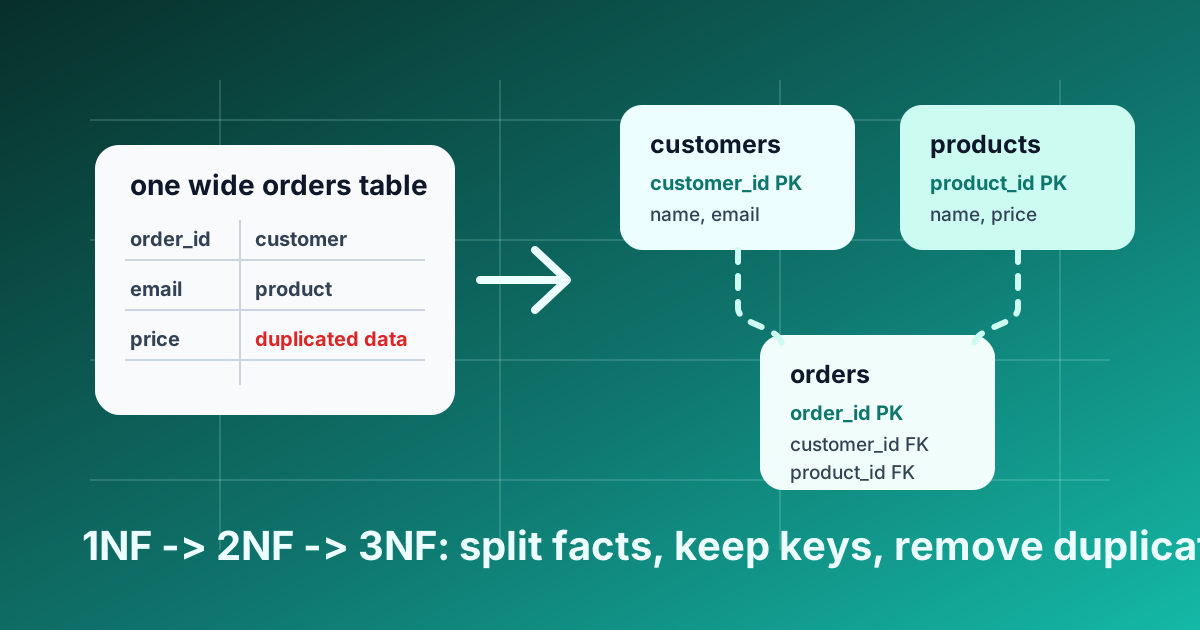
A new engineer designing their first schema almost always builds it the way they would build a spreadsheet. One big table with every field they can think of. Maybe two if they get fancy. The application works on the first day, breaks subtly on the second week, and becomes a nightmare to refactor by the third month. Most of those headaches come from one specific issue: the schema is denormalized, and nobody noticed until the data started fighting back.
Database normalization is a well-defined process for organizing tables so that each piece of information lives in exactly one place. It has been the standard for relational database design since the 1970s. The terminology is intimidating — "first normal form," "third normal form," "Boyce-Codd normal form" — but the underlying ideas are common-sense rules that prevent specific kinds of bugs.
This article is normalization translated into plain English with examples that real engineers actually run into. By the end you will be able to look at a schema and say which normal form it is in, what bugs that opens it up to, and how to fix them.
The Schema That Goes Wrong First
Suppose you are building a course platform. Your first instinct is something like:
courses
─────────────────────────────────────────────────────────────────
id  | title           | instructor_name  | instructor_email      | tags
1   | AI Engineering  | Divyanshu Singh  | [email protected]      | ai, cloud
2   | Docker Basics   | Divyanshu Singh  | [email protected]      | devops, docker
3   | Vue Mastery     | Sarah Lee        | [email protected]     | vue, frontend
This works. You can SELECT * FROM courses and see everything. You can show a course page with one query. The application code is short.
It also has three latent problems that will hurt you within a month:
- Update anomaly. Divyanshu changes his email. You have to find every row with his name and update the email. If you miss one, the data is now contradictory. Did Divyanshu have two emails? You cannot tell.
- Insertion anomaly. A new instructor signs up but has not created a course yet. There is no row to put their information in. You either fake a placeholder course (ugly), allow nullable instructor info (ugly different way), or invent a separate workaround.
- Deletion anomaly. You delete the only course Divyanshu teaches. His email is now nowhere in the database. The next time you need to email him, you have lost the data.
These are the anomalies normalization is designed to prevent. Each "normal form" is a specific guarantee that closes off a specific class of anomaly.
First Normal Form (1NF) — Atomic Values, No Repeats
A table is in 1NF when:
- Every cell holds a single value (no comma-separated lists).
- Every row is unique.
- The order of rows does not carry meaning.
The schema above fails 1NF because of the tags column — "ai, cloud" is a comma-separated list, not a single value. To query "all AI courses" you have to do string parsing, which is slow and bug-prone.
The 1NF fix is to split the tags into a separate table:
courses                              course_tags
─────────────────────────────        ────────────────────────────
id  | title           | ...          course_id | tag
1   | AI Engineering  | ...          1         | ai
2   | Docker Basics   | ...          1         | cloud
3   | Vue Mastery     | ...          2         | devops
                                     2         | docker
                                     3         | vue
                                     3         | frontend
Now "all AI courses" is a clean SQL query: SELECT c.* FROM courses c JOIN course_tags ct ON ct.course_id = c.id WHERE ct.tag = 'ai'. Indexes work. Constraints work. Counting tags works.
Any column that holds "a list of things" should be split into a join table. This is the single most common schema fix.
Second Normal Form (2NF) — No Partial Dependencies on Composite Keys
A table is in 2NF when it is in 1NF and no non-key column depends on only part of a composite primary key. This matters only when your primary key is multiple columns combined.
Most simple tables (single-column primary key like id) are automatically in 2NF if they are in 1NF. The problem appears in join tables when you accidentally pile attributes onto them.
Bad example — a course-enrollment table that tracks both the enrollment and instructor info:
enrollments
──────────────────────────────────────────────────
course_id | student_id | instructor_name | enrolled_at
1         | 100        | Divyanshu Singh | 2026-01-15
1         | 101        | Divyanshu Singh | 2026-01-18
2         | 100        | Divyanshu Singh | 2026-01-20
3         | 100        | Sarah Lee       | 2026-02-01
The primary key is (course_id, student_id). But instructor_name depends only on course_id, not on the full key. This is a 2NF violation. The same instructor name is repeated for every student in a course. Updating the instructor name requires updating every row.
The 2NF fix is to move instructor_name to the courses table where it belongs:
courses                              enrollments
─────────────────────────────        ──────────────────────────────
id | title          | instructor      course_id | student_id | enrolled_at
1  | AI Engineering | Divyanshu       1         | 100        | 2026-01-15
2  | Docker Basics  | Divyanshu       1         | 101        | 2026-01-18
3  | Vue Mastery    | Sarah           2         | 100        | 2026-01-20
                                      3         | 100        | 2026-02-01
Each piece of information now lives in exactly one place. An instructor name change updates one row in courses and propagates correctly to every query.
Third Normal Form (3NF) — No Transitive Dependencies
A table is in 3NF when it is in 2NF and no non-key column depends on another non-key column. This is the form most schemas should aim for, and it is where the example schema from the start fails most spectacularly.
In the original courses table:
id | title | instructor_name | instructor_email
instructor_email does not depend on id (the primary key). It depends on instructor_name. That is a transitive dependency — id → instructor_name → instructor_email. Multiple courses with the same instructor have the same email duplicated. Update one row, the rest are inconsistent.
The 3NF fix is to put instructors in their own table:
instructors                          courses
────────────────────────────         ──────────────────────────
id | name           | email          id | title           | instructor_id
1  | Divyanshu      | div@...        1  | AI Engineering  | 1
2  | Sarah Lee      | sarah@...      2  | Docker Basics   | 1
                                     3  | Vue Mastery     | 2
courses.instructor_id is a foreign key referencing instructors.id. Each instructor exists once. Email changes once. New instructors can be added before they have any courses. Deleting their last course does not lose their data. All three anomalies from the start are gone.
This is the schema design almost every relational database should land at. Most schemas in the wild do not need to go further than 3NF.
Boyce-Codd, 4NF, 5NF — When You Need Them
Higher normal forms exist for edge cases:
- BCNF (Boyce-Codd Normal Form) — a stricter version of 3NF that closes a loophole when a table has multiple overlapping candidate keys. Rare in practice.
- 4NF and 5NF — for tables with multi-valued dependencies (rare, usually appearing in many-to-many-to-many relationships).
You can build a career and rarely encounter a BCNF violation that 3NF does not also catch. They are worth knowing exist; they are not worth optimizing for upfront.
When to Denormalize on Purpose
Normalization is the default. Denormalization — deliberately violating it — is sometimes the right answer for specific reasons:
Performance. A query that joins five tables is slower than a query against one denormalized table. If a critical read path runs millions of times per second and the join cost is too high, denormalizing the joined data into one table can be the right answer.
Reporting. Reporting and analytics queries often run against denormalized data warehouses (star schemas, OLAP cubes). The transactional database is normalized for write integrity; the warehouse is denormalized for read speed.
Caching. A normalized database with a denormalized cache (Redis holding the joined view) is the most common production pattern. The cache is a denormalization on purpose, controlled by code, and rebuilt from the normalized source of truth.
The discipline is: normalize first, denormalize with intention. A denormalized schema "for performance" without measurement is usually slower in practice once you account for the operational cost of keeping duplicated data consistent.
A Practical Process for Designing a New Schema
When I am designing a schema for a new project:
- List the entities — the nouns the system deals with. User, Course, Lesson, Enrollment, Comment.
- Identify the relationships — does User have many Courses? Does Course have many Lessons? One-to-many, many-to-many, one-to-one.
- Draw the tables — one table per entity, with the obvious primary key (
id). - Add the relationships — one-to-many gets a foreign key in the "many" table; many-to-many gets a join table.
- Check 3NF for each table — every non-key column should depend on the key, the whole key, and nothing but the key.
- Add indexes for the queries you know about — every foreign key, every column you filter on, every column you order by.
This process produces a 3NF schema that handles almost every typical application. The remaining cases involve complex edge cases where you knowingly denormalize for specific reasons.
Where This Fits
Lesson 14 of the ABCsteps curriculum designs the schema for a leaderboard project using SQLite. This article gives you the rules behind a good schema so the lesson's design feels principled instead of arbitrary. By the end you will be able to look at a database design and recognize whether it is normalized, what anomalies it is exposed to, and whether the denormalization (if any) was deliberate or accidental.
Apply this hands-on · Module C
Databases: Store Data Permanently
Lesson 14 designs a small schema for a leaderboard. This article gives you the normalization rules so the schema choices feel principled, not improvised.



Skill vocabulary from the lesson
Tool logos are curriculum references only: no affiliation, hiring promise, salary promise, or placement guarantee.
Company skill surface
Data-backed product teams need engineers who know what must persist and what can remain temporary.






Team contexts
Backend teams, Data applications, Product analytics
Proof prompt
Show the table shape, one insert, one read, and the reason the data survives a refresh.
Company and platform logos are ecosystem references only: no affiliation, endorsement, interview access, hiring preference, salary outcome, or placement guarantee.
Open lesson
Divyanshu Singh Chouhan
Founder, ABCsteps Technologies
Founder of ABCsteps Technologies. Building a 20-lesson AI engineering course that teaches AI, ML, cloud, and full-stack development through written lessons and real projects.


After this article
Choose the next proof-bearing step.
Do not collect another article by default. Move into a public lesson, continue a focused path, or bring a concrete repo question to a paid-plan conversation.
Use paid guidance only when it changes the artifact: a repo, demo, written note, architecture decision, or review trail another person can inspect.
 Build
BuildContinue public lessons
Open the 20-lesson path and turn the concept into a runnable artifact.
ReadFollow a focused path
Use a short article sequence only when one lesson needs more context.
DecideCompare plans
Use a paid plan only if feedback, accountability, or review would change the work.
 Ask
AskAsk with context
Send the lesson, repo, error, or decision you want reviewed before scheduling a call or review.
Related Articles
On this page
Article context
Structured data surface
Read this article as data vocabulary: shape, validation, storage, query behavior, and contracts between systems.

Tool and platform logos are article-context references only: no affiliation, endorsement, interview access, hiring promise, salary promise, or placement guarantee.
Share