What is an API and How Do APIs Actually Work
What an API actually is, the request-response cycle, the HTTP methods that matter, status codes that communicate, idempotency, and the architectural difference between REST, GraphQL, and gRPC.

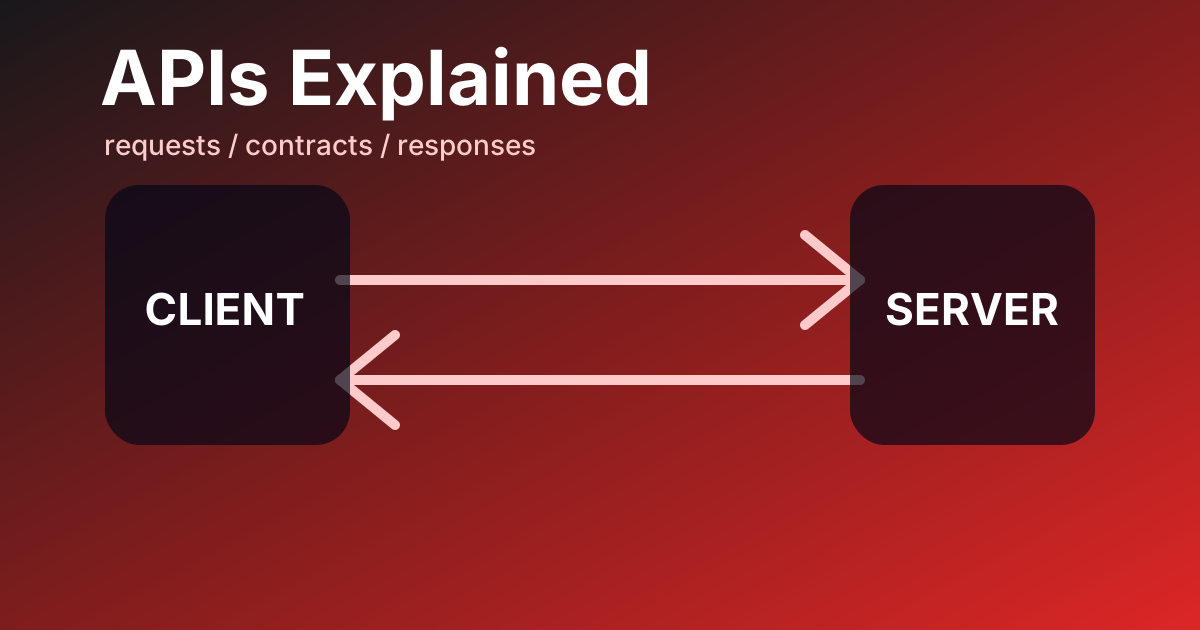
Understanding the Core Components of an API
To understand an Application Programming Interface (API), it is helpful to break down the acronym into its constituent parts. Each word represents a specific layer of the technology's function within a software ecosystem.
- Application: This refers to any software program that performs a specific function. It could be a complex database, a mobile weather app, or a microservice responsible for processing credit card payments.
- Programming: This denotes the code-based nature of the interaction. Unlike a User Interface (UI) designed for human interaction via buttons and screens, an API is designed for software to interact with software using code, protocols, and data structures.
- Interface: This is the point of contact. In the physical world, a power outlet is an interface between an appliance and the electrical grid. In software, the API is the boundary where two systems exchange instructions and data without needing to know how the other system is internally constructed.
An API is a formal contract between a provider and a consumer. It specifies what requests can be made, how to make them, and what the expected response will be. This abstraction lets developers use complex functionality — processing a biometric login, calculating a shipping route, sending an SMS — by simply "calling" the interface rather than writing the underlying logic from scratch.
The Evolution of Connectivity: Local vs. Web APIs
While the modern conversation around APIs usually centers on the internet, the concept is as old as computing itself. Understanding the distinction between local and web-based APIs is essential for engineering clarity.
Local APIs
Historically, APIs were used to allow software to communicate with the operating system (OS) or hardware. For example, when a text editor needs to print a document, it does not communicate directly with the printer hardware. Instead, it uses a local API provided by the operating system (such as the Windows API or macOS Cocoa) to send the print command. The OS handles the hardware drivers and resource management, while the application remains focused on text editing.
Web-Based APIs (Web Services)
The rise of distributed computing shifted the focus toward web APIs. These interfaces allow systems to communicate over a network, typically using the Hypertext Transfer Protocol (HTTP). While the terms "API" and "Web Service" are often used interchangeably, there is a technical distinction: all web services are APIs, but not all APIs are web services. A web service specifically requires a network connection and usually follows a standardized protocol like REST or SOAP.
In day-to-day engineering today, "API" almost always means "web API" — a server you talk to over HTTP, in JSON, that returns structured data. The internet has shifted from a medium where humans browse to one where machines exchange data on humans' behalf. The browser tab you have open is, more often than not, a thin frontend over a stack of API calls.
The Mechanics of the Request-Response Cycle
The fundamental operation of a web API is the Request-Response Cycle. This is a structured exchange where a client (the requester) sends a message to a server (the provider), and the server returns a result.
1. The Anatomy of a Request
An API request must follow a strict structure to be understood by the server. It typically consists of four main components:
- The Endpoint: This is the Uniform Resource Locator (URL) that acts as the digital address of the resource. For example,
https://api.example.com/v1/products/123points to a specific product in a database. - The HTTP Method (Verb): This defines the action the client wants to perform.
GET: Retrieve data (read-only).POST: Create a new resource.PUT: Update an existing resource entirely.PATCH: Apply partial updates to a resource.DELETE: Remove a resource.
- Headers: These contain metadata about the request. Common headers include
Content-Type(e.g.,application/json),Authorization(API keys or tokens), andUser-Agent. - The Body (Payload): This is the data being sent to the server, usually required for
POST,PUT, orPATCHrequests.
2. Processing and Logic
Once the server receives the request, it validates the authentication and checks if the endpoint exists. If valid, the server executes the "backend" logic. This might involve querying a SQL database, performing a calculation, or triggering a physical action in an IoT device. The client remains "abstracted" from this process; it only cares about the final output, not the complexity of the server's internal operations.
3. The Anatomy of a Response
The server sends back a response that includes a Status Code and, usually, a Data Payload. The status code is a three-digit number that informs the client of the outcome:
| Status Code | Meaning | Description |
|---|---|---|
| 200 | OK | The request was successful. |
| 201 | Created | A new resource was successfully created. |
| 400 | Bad Request | The request was malformed or missing data. |
| 401 | Unauthorized | Authentication failed or was not provided. |
| 403 | Forbidden | Authenticated, but lacks permission for this resource. |
| 404 | Not Found | The requested endpoint or resource does not exist. |
| 500 | Internal Error | The server encountered an unexpected condition. |
Data Serialization: Why JSON Dominates
For two systems to communicate, they must agree on a data format. In the early 2000s, XML (eXtensible Markup Language) was the industry standard. However, XML is "verbose"—it uses extensive tags that increase the size of the data packet, leading to higher latency and bandwidth costs.
Today, JSON (JavaScript Object Notation) is the standard for modern APIs. JSON is a lightweight, text-based format that is easy for humans to read and highly efficient for machines to parse.
{
  "user": {
    "id": 550,
    "name": "Jane Doe",
    "email": "[email protected]",
    "roles": ["admin", "editor"]
  },
  "status": "active"
}
While JSON originated from JavaScript, it is language-independent. Whether a backend is written in Python, Java, Go, or Ruby, it can natively serialize (convert objects to JSON) and deserialize (convert JSON back to objects) this data. This interoperability is what allows a mobile app written in Swift to communicate seamlessly with a server written in C#.
Architectural Styles: Comparing REST, GraphQL, and gRPC
Not all APIs are built the same way. Developers choose different architectural styles based on the specific needs of the application, such as speed, flexibility, or strictness.
REST (Representational State Transfer)
REST is the most common architecture for web APIs. It is "stateless," meaning the server does not store any information about the client between requests. Each request must contain all the information necessary to be fulfilled.
- Pros: Highly scalable, easy to cache, and works over standard HTTP.
- Cons: Can lead to "over-fetching" (receiving more data than needed) or "under-fetching" (needing multiple requests to get all required data).
GraphQL
Developed by Facebook, GraphQL is a query language for APIs. Instead of having multiple endpoints for different data (e.g., /users, /posts, /comments), GraphQL uses a single endpoint. The client specifies exactly which fields it wants.
- Pros: Eliminates over-fetching; highly flexible for frontend developers.
- Cons: More complex to implement on the server side; difficult to cache compared to REST.
gRPC (Google Remote Procedure Call)
gRPC is a high-performance framework that uses Protocol Buffers (Protobuf) instead of JSON. It is designed for internal communication between microservices where speed is critical.
- Pros: Extremely fast; uses binary serialization; supports streaming.
- Cons: Not human-readable; limited browser support; requires specific tooling.
The Concept of Idempotency in API Design
In engineering, idempotency is a crucial concept for building reliable APIs. An idempotent operation is one that can be performed multiple times without changing the result beyond the initial application.
- GET is idempotent. Calling it ten times to view a profile yields the same result and changes nothing on the server.
- PUT is idempotent. If you update a user's email to
[email protected]five times, the end state of the database is the same as if you did it once. - POST is not idempotent. If a client sends a "Create Order" request five times (perhaps due to a lagging internet connection), and the API is not designed to handle it, the server might create five separate orders and charge the customer five times.
Professional API design often uses "Idempotency Keys" in headers to ensure that retried requests do not result in duplicate side effects.
API Security and Governance
As APIs become the primary gateways to sensitive data, securing them is a top priority. A breach in an API can expose millions of records, as seen in various high-profile data leaks.
Authentication vs. Authorization
- Authentication verifies who the requester is. This is usually handled via API Keys (a simple string) or OAuth2/JWT (JSON Web Tokens), which are more secure and time-limited.
- Authorization determines what the requester is allowed to do. Even if a user is authenticated, they should not be authorized to delete another user's data. This is often managed through Scopes or Role-Based Access Control (RBAC).
Rate Limiting and Throttling
To prevent abuse or accidental Denial of Service (DoS) attacks, providers implement Rate Limiting. This restricts the number of requests a client can make within a specific timeframe (e.g., 1,000 requests per hour). Common algorithms include the "Leaky Bucket" or "Token Bucket" methods, which smooth out traffic spikes to protect server stability.
CORS (Cross-Origin Resource Sharing)
CORS is a security mechanism that allows a server to specify which "origins" (domains) are permitted to access its resources. This prevents malicious websites from making unauthorized requests to an API on behalf of a user.
The Role of Documentation and Developer Experience (DX)
An API is only as useful as its documentation. Since the "users" of an API are other engineers, the quality of the Developer Experience (DX) determines the adoption of the technology.
Modern industry standards utilize the OpenAPI Specification (formerly Swagger). This allows developers to create machine-readable descriptions of their APIs. These specifications can automatically generate:
- Interactive Documentation: Websites where developers can test endpoints directly in the browser.
- Client SDKs: Pre-written code libraries in various languages (Python, JavaScript, etc.) that make it easier to integrate the API.
- Mock Servers: Fake servers that return sample data, allowing frontend and backend teams to work in parallel.
The API Economy: Real-World Business Impact
The "API Economy" refers to the business model where companies monetize their data or functionality by providing it as a service.
- Stripe: Instead of businesses building their own complex payment infrastructure, they integrate Stripe’s API. Stripe handles the security, banking relationships, and regulatory compliance, while the business pays a small fee per transaction.
- Twilio: Allows developers to send SMS or make phone calls via a simple API call, abstracting away the massive complexity of global telecommunications networks.
- Weather Data: Companies like AccuWeather or OpenWeatherMap sell access to meteorological data. A gardening app, a drone flight controller, and a logistics company all use the same API to get the data they need for their specific use cases.
This modular composition is why a small team can ship a payments-enabled, SMS-notifying, weather-aware product in a weekend. Companies no longer build every component of their software from scratch — they assemble best-in-class services through APIs, focusing engineering effort on the parts that are actually their differentiator.
Future Trends: AI and Edge Computing
The landscape of APIs continues to evolve with the emergence of new technologies.
AI-as-a-Service
The rise of Large Language Models (LLMs) like GPT-4 has created a new category of APIs. Companies like OpenAI and Anthropic provide API access to their models, allowing developers to add generative AI capabilities to their apps without needing the billions of dollars required to train the underlying models.
Edge APIs
With the growth of Edge Computing, API processing is moving closer to the user. Instead of a request traveling to a centralized data center in Virginia, it might be processed at a Cloudflare or AWS Lambda@Edge node just miles from the user. This reduces latency to single-digit milliseconds, which is critical for autonomous vehicles, real-time gaming, and high-frequency trading.
What to do next
APIs are best learned by sending real requests, not by reading more articles. Three concrete actions:
- Open your terminal and
curla public API: trycurl https://api.github.com/users/torvalds. Read the JSON. Note the structure. Notice the rate-limit headers. - Make a
POSTto a free echo service likehttps://httpbin.org/postwith a JSON body — verify the body comes back, inspect the headers it received. This is the request-response cycle made visible. - Pick one API for a service you actually use (Stripe, Twilio, OpenWeatherMap, GitHub). Read the first three endpoints in their docs. Notice the design choices — naming, idempotency keys, pagination shape. Good APIs are studied like good code.
When you're ready to call APIs from a real interface and use their responses in a working app, that's exactly what ABCsteps Lesson 09 — APIs Revealed — walks you through. And once you can call APIs, the next step is building one yourself, which is Lesson 13.
Apply this hands-on · Module B
How Apps Talk: APIs Revealed
Lesson 09 has you actually call a public API, inspect the response, and use the data in a working interface. This article gives you the model; the lesson gives you the muscle memory of the tools.



Skill vocabulary from the lesson
Tool logos are curriculum references only: no affiliation, hiring promise, salary promise, or placement guarantee.
Company skill surface
API thinking is a cross-company skill because every useful product eventually talks to another system.






Team contexts
Backend engineering, Integration teams, Full-stack product teams
Proof prompt
Show the request, response, status code, and how the UI changed after reading the payload.
Company and platform logos are ecosystem references only: no affiliation, endorsement, interview access, hiring preference, salary outcome, or placement guarantee.
Open lesson
Divyanshu Singh Chouhan
Founder, ABCsteps Technologies
Founder of ABCsteps Technologies. Building a 20-lesson AI engineering course that teaches AI, ML, cloud, and full-stack development through written lessons and real projects.


After this article
Choose the next proof-bearing step.
Do not collect another article by default. Move into a public lesson, continue a focused path, or bring a concrete repo question to a paid-plan conversation.
Use paid guidance only when it changes the artifact: a repo, demo, written note, architecture decision, or review trail another person can inspect.
 Build
BuildContinue public lessons
Open the 20-lesson path and turn the concept into a runnable artifact.
 Read
ReadFollow a focused path
Use a short article sequence only when one lesson needs more context.
DecideCompare plans
Use a paid plan only if feedback, accountability, or review would change the work.
 Ask
AskAsk with context
Send the lesson, repo, error, or decision you want reviewed before scheduling a call or review.
Related Articles
On this page
Article context
Structured data surface
Read this article as data vocabulary: shape, validation, storage, query behavior, and contracts between systems.

Tool and platform logos are article-context references only: no affiliation, endorsement, interview access, hiring promise, salary promise, or placement guarantee.
Share